





 Using Interfering Sound Waves for Monopile Investigation
Offshore wind farm operators face a challenge when trying to establish the integrity of the monopile-transition piece interface which has been used in 80% of turbines constructed before 2012. A key focus is the layer of grout which bonds the two steel sections of the structure, the integrity of which could affect the turbine’s long-term stability. Uniper Technologies, working with a team from the British Geological Survey, has developed a system, the first of its kind, which uses interfering sound waves to investigate the monopile-transition piece underwater and highlight any areas of defective or missing grout. The system, which has been successfully trialled at sea, was a winner of the recent Subsea Inspection competition organised by the Carbon Trust’s Offshore Wind Accelerator. Importantly the technique can inspect the structure from a single surface and within the tight timescales required for offshore procedures. Inspection data is interpreted and shared in a transparent format.
By Dr Colin Brett, Head of Inspection, Uniper Technologies, UK
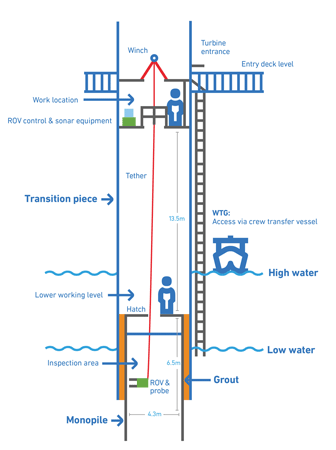
The majority of offshore wind turbines constructed before 2012 use a system in which grout – a high-strength, fast-curing cement – is pumped between the steel monopile and transition piece (see Figure 1). An estimated 35–40% of monopile turbines have potential grouted joint issues, and so an inspection technique that is accurate and meets operational requirements has major potential benefit for the offshore industry.