



Bringing Industrial Automation to Wind Farms
 About three years ago, while I [Bruce] was sharing a drink with some friends, the evening’s conversation turned to wind turbines. One of the gentlemen at the table was managing a blade refurbishment project in Iowa, USA, that was behind schedule and over budget. His problem was related to the removal and re-installation of the blades. The project was constantly being held up by weather conditions unsuitable for crane operations, and the additional time delays and crane costs were threatening his project. Having experience with industrial robotics and composites, I asked him if it was possible to paint the blades in place and eliminate the crane entirely. ‘You’re nuts, that would never work!’ was his reply, and the next morning Helical Robotics was born. The following story outlines the solutions we have created to fix this sort of problem, and the machines that make it possible.
By Bruce Schlee and Derek Berquist, Helical Robotics, USA
Helical Robotics is advancing technologies that will make the construction, operation and maintenance of wind turbines cheaper, faster and more reliable. With the end of the Production Tax Credit in the USA, and an ageing wind fleet, operators are looking to cut ongoing costs and increase production efficiency. Helical Robotics believes it may have an answer.
Wind tower access has traditionally required the use of cranes, bucket trucks, repelling teams or any combination of the three. Since Helical Robotics was founded in 2010, engineers at our Wisconsin-based company have created ways to streamline the work using remote-controlled, robotic devices that can scale a wind tower without any additional equipment. Over the past 2½ years our team has designed, patented and manufactured some of the most unusual omnidirectional machines in the world.
Our motivation is to allow for a more efficient and safer wind farm. This is accomplished by reducing the time and expense required to perform work while completing it from the safety of the ground. Robots have the ability to remain in use even when weather conditions would not permit traditional tower scaling. Testing has shown that some of the systems remain stable in wind speeds approaching 26m/s. This allows service teams to expand their working envelope, thus reducing downtime and increasing efficiency. Using this new technology, technicians have a real-time view of tower maintenance operations from on-board cameras, and off-site personnel can view the progress live. As Keith Schlee, creator of the Helical Robotics platforms, summarises it: ‘Allowing work in the field to be seen in real-time by anyone in the organisation greatly reduces the time between problem and solution’.
Operations and maintenance is one of the most costly areas in wind power production. According to Wind Energy Update, ‘Operations and maintenance can account for as much as 26% of the total cost of a wind farm over the course of its lifetime’. Reducing this cost is critically important if the wind energy industry worldwide is to remain competitive with other sources of power. Helical Robotics has been working with industry experts as well as investing heavily in research and development in 2010, 2011 and 2012, and has built a world-class portfolio of robotic solutions. We are incorporating leading-edge technology, global resources and services available to create a network of advanced robotic platforms that will change the face of infrastructure worldwide.
From the outset, we have positioned ourselves as a systems design and integration company, with the idea that payloads are chosen based on customer needs. Robotic platforms are engineered to order and can be fitted with a wide range of devices, from cameras and testing equipment, to robotic arms and lifts. Helical Robotics is working with clients to design systems for wind, as well as other industries. Ultimately, we plan to provide off-the-shelf solutions for the most common tasks.
Currently, Helical Robotics is working with two base technologies, the HR-1000 Series and HR-2000 Series platforms. The HR-1000 Series use single and multi-segment designs, along with either neodymium or electromagnets to adhere to ferrous surfaces. The HR-2000 Series of platforms, still under development, use a multi-segment design to wrap around any variable surface, and pneumatic or hydraulic cylinders to apply a clamping force. This allows the platform to be used on non-ferrous surfaces.
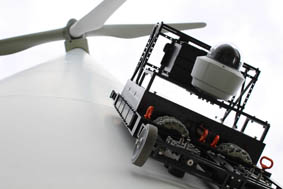
HR-1000 Series robotic platforms use a patent-pending magnetic adhesion system that combines magnetic force with wheel friction to create the first omnidirectional robot that can drive in any surface orientation. To achieve this, the magnets are held slightly off the work surface to eliminate friction and prevent damage to painted structures. The external down force created by the magnets holds the robot against the surface, while its Mecanum wheels allow manoeuvring in any direction. Because of the strong magnetic forces generated the robot can carry a wide range of payloads on any ferrous surface.
There are many benefits to a magnetic system on wind towers versus other forms of adhesion. The first is ease of scalability. By adding additional magnets, wheels or segments, it is possible to lift as much weight as the structure will support. The limitation is the structure that the robot is placed on, not the robot itself. A chassis can be made as small or as large as the job demands or even chained together to form a multi-module robot with higher lift capacity. Also, there is no need to tether the machine off the tower or nacelle. Since we are using permanent magnets, the machine will stay on the tower even if all external power systems fail. This also gives the system an in-place loiter capability for applications such as long-duration testing or observation. All of this leads to a machine that is versatile, yet simple to use.
In early June, Helical Robotics chose the American Wind Energy Association (AWEA) 2012 Conference and Exposition in Atlanta, Georgia, to unveil its newest platform, the HR-1000LL. This system helps expand our offering of robotic platforms by creating a portable unit that allows a single operator to lift many kilograms up-tower, safely from the ground. The reaction from companies has been overwhelming and we could not be happier with the response we have received. Demonstrating a new technology to thousands of industry leaders has created quite a buzz, and we are confident that the technology will be implemented across a wide range of businesses.
HR-2000 Series platforms use a patent-pending multi-segment design to wrap around a surface, and pneumatic or hydraulic cylinders to apply a clamping force. The segments then work as a single unit allowing for movement in any direction on any shape. This was the first system that we designed with an ultimate goal of wrapping it around a wind blade and performing up-tower repair. We hope that this design concept will one day change the way work is done on infrastructure projects around the world. It is still in need of extensive refinement and systems design, but the technology already exists to make this a truly remarkable machine. We have built this system in small scale and it really is something to watch. It looks otherworldly when it moves, but at the same time there is a beautiful, almost organic nature to its motion. At some point we will have a client that needs this machine, and at that time we are sure the final product will be quite impressive.
Helical Robotics is also exploring ways to take this technology into other industries. We are in the process of developing platforms and seeking business partners in the conventional energy space, shipping and steel structure areas to name a few . At Helical Robotics we like to ask, ‘What can Helical Robotics do for you?’ Contact us and we’ll work together to find an answer.
Biography of the Authors
Bruce Schlee, who graduated with degrees in Business Administration and Aviation Science, is an entrepreneur. Derek Berquist is an IT professional with over 20 years of advanced design and implementation experience. Together with his team Keith Schlee has created one of the most innovative products in mobile robotics.{/access}
About three years ago, while I [Bruce] was sharing a drink with some friends, the evening’s conversation turned to wind turbines. One of the gentlemen at the table was managing a blade refurbishment project in Iowa, USA, that was behind schedule and over budget. His problem was related to the removal and re-installation of the blades. The project was constantly being held up by weather conditions unsuitable for crane operations, and the additional time delays and crane costs were threatening his project. Having experience with industrial robotics and composites, I asked him if it was possible to paint the blades in place and eliminate the crane entirely. ‘You’re nuts, that would never work!’ was his reply, and the next morning Helical Robotics was born. The following story outlines the solutions we have created to fix this sort of problem, and the machines that make it possible.By Bruce Schlee and Derek Berquist, Helical Robotics, USA
{access view=!registered}Only logged in users can view the full text of the article.{/access}{access view=registered}
Helical Robotics is advancing technologies that will make the construction, operation and maintenance of wind turbines cheaper, faster and more reliable. With the end of the Production Tax Credit in the USA, and an ageing wind fleet, operators are looking to cut ongoing costs and increase production efficiency. Helical Robotics believes it may have an answer.
Wind tower access has traditionally required the use of cranes, bucket trucks, repelling teams or any combination of the three. Since Helical Robotics was founded in 2010, engineers at our Wisconsin-based company have created ways to streamline the work using remote-controlled, robotic devices that can scale a wind tower without any additional equipment. Over the past 2½ years our team has designed, patented and manufactured some of the most unusual omnidirectional machines in the world.
Our motivation is to allow for a more efficient and safer wind farm. This is accomplished by reducing the time and expense required to perform work while completing it from the safety of the ground. Robots have the ability to remain in use even when weather conditions would not permit traditional tower scaling. Testing has shown that some of the systems remain stable in wind speeds approaching 26m/s. This allows service teams to expand their working envelope, thus reducing downtime and increasing efficiency. Using this new technology, technicians have a real-time view of tower maintenance operations from on-board cameras, and off-site personnel can view the progress live. As Keith Schlee, creator of the Helical Robotics platforms, summarises it: ‘Allowing work in the field to be seen in real-time by anyone in the organisation greatly reduces the time between problem and solution’.
Operations and maintenance is one of the most costly areas in wind power production. According to Wind Energy Update, ‘Operations and maintenance can account for as much as 26% of the total cost of a wind farm over the course of its lifetime’. Reducing this cost is critically important if the wind energy industry worldwide is to remain competitive with other sources of power. Helical Robotics has been working with industry experts as well as investing heavily in research and development in 2010, 2011 and 2012, and has built a world-class portfolio of robotic solutions. We are incorporating leading-edge technology, global resources and services available to create a network of advanced robotic platforms that will change the face of infrastructure worldwide.
From the outset, we have positioned ourselves as a systems design and integration company, with the idea that payloads are chosen based on customer needs. Robotic platforms are engineered to order and can be fitted with a wide range of devices, from cameras and testing equipment, to robotic arms and lifts. Helical Robotics is working with clients to design systems for wind, as well as other industries. Ultimately, we plan to provide off-the-shelf solutions for the most common tasks.
Currently, Helical Robotics is working with two base technologies, the HR-1000 Series and HR-2000 Series platforms. The HR-1000 Series use single and multi-segment designs, along with either neodymium or electromagnets to adhere to ferrous surfaces. The HR-2000 Series of platforms, still under development, use a multi-segment design to wrap around any variable surface, and pneumatic or hydraulic cylinders to apply a clamping force. This allows the platform to be used on non-ferrous surfaces.
HR-1000 Series robotic platforms use a patent-pending magnetic adhesion system that combines magnetic force with wheel friction to create the first omnidirectional robot that can drive in any surface orientation. To achieve this, the magnets are held slightly off the work surface to eliminate friction and prevent damage to painted structures. The external down force created by the magnets holds the robot against the surface, while its Mecanum wheels allow manoeuvring in any direction. Because of the strong magnetic forces generated the robot can carry a wide range of payloads on any ferrous surface.
There are many benefits to a magnetic system on wind towers versus other forms of adhesion. The first is ease of scalability. By adding additional magnets, wheels or segments, it is possible to lift as much weight as the structure will support. The limitation is the structure that the robot is placed on, not the robot itself. A chassis can be made as small or as large as the job demands or even chained together to form a multi-module robot with higher lift capacity. Also, there is no need to tether the machine off the tower or nacelle. Since we are using permanent magnets, the machine will stay on the tower even if all external power systems fail. This also gives the system an in-place loiter capability for applications such as long-duration testing or observation. All of this leads to a machine that is versatile, yet simple to use.
In early June, Helical Robotics chose the American Wind Energy Association (AWEA) 2012 Conference and Exposition in Atlanta, Georgia, to unveil its newest platform, the HR-1000LL. This system helps expand our offering of robotic platforms by creating a portable unit that allows a single operator to lift many kilograms up-tower, safely from the ground. The reaction from companies has been overwhelming and we could not be happier with the response we have received. Demonstrating a new technology to thousands of industry leaders has created quite a buzz, and we are confident that the technology will be implemented across a wide range of businesses.
HR-2000 Series platforms use a patent-pending multi-segment design to wrap around a surface, and pneumatic or hydraulic cylinders to apply a clamping force. The segments then work as a single unit allowing for movement in any direction on any shape. This was the first system that we designed with an ultimate goal of wrapping it around a wind blade and performing up-tower repair. We hope that this design concept will one day change the way work is done on infrastructure projects around the world. It is still in need of extensive refinement and systems design, but the technology already exists to make this a truly remarkable machine. We have built this system in small scale and it really is something to watch. It looks otherworldly when it moves, but at the same time there is a beautiful, almost organic nature to its motion. At some point we will have a client that needs this machine, and at that time we are sure the final product will be quite impressive.
Helical Robotics is also exploring ways to take this technology into other industries. We are in the process of developing platforms and seeking business partners in the conventional energy space, shipping and steel structure areas to name a few . At Helical Robotics we like to ask, ‘What can Helical Robotics do for you?’ Contact us and we’ll work together to find an answer.
Biography of the Authors
Bruce Schlee, who graduated with degrees in Business Administration and Aviation Science, is an entrepreneur. Derek Berquist is an IT professional with over 20 years of advanced design and implementation experience. Together with his team Keith Schlee has created one of the most innovative products in mobile robotics.{/access}