



Using Pneumatic Power to Generate Wind Energy
Over 60 years ago a 100kW test wind turbine was built with pneumatic power transmission in southern England (Figure 1), based on a design patented by M. Andreau. Test results from the turbine showed a lower energy extraction than was obtained by wind turbines with conventional mechanical power transmission, and therefore the pneumatic power transmission was abandoned, without attempting to improve it. Our team has re-investigated this type of transmission, and following a number of patented innovations we have been able to considerably improve on the previous results. We are now hoping to upscale our working models for field testing.
By Dr Endre Mucsy, Hungary
Below we discuss the differences between conventional and pneumatic turbine types and their resulting properties. Why was the potential of pneumatic power transmission underestimated and abandoned? What design changes did we make to improve the efficiency of the pneumatic turbine, and how have we tested them? Finally, how much energy is there in the wind and what proportion can be utilised?
Construction of the Two Turbine Types
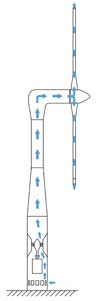
In conventional wind turbines the rotor turns the generator through a mechanical coupling. The speed is increased by a multiplying gear with a ratio of about 1:100 built in between the two shafts. According to conventional wisdom, this drive train is the critical element of wind turbines, and pneumatic power transmission was intended to replace this part of the machine. In a pneumatic system the turbine rotates freely and is not connected to a gear train. The blades, rotor head and tower all form a closed continuous air duct (Figure 2). An air turbine generator is located at the base of the tower, close to the inlet into this air duct. When the wind turns the main blades, vents located in these blades allow air to be sucked out by the low pressure area created at their surface by their aerofoil cross-section.. This suction moves the air in the duct, and the air flowing inside the tower turns the air turbine generator.
Further Comparisons
In both turbines friction and drag are major sources of losses but their effects are different. In conventional turbines friction is determinant, while in pneumatic wind turbines drag is the key factor. Figure 3 shows estimated losses of the two types of turbines versus wind speed. The extent of friction loss is demonstrated by the fact that large mechanical turbines can only be started when the wind speed exceeds 5m/s, because at this speed the net power obtained from the wind exceeds losses. In contrast, our pneumatic test turbine started to rotate at a wind speed as low as 1m/s and reached a measurable output at a wind speed of 2m/s.
Also, in pneumatic wind turbines there will be no gear drive or devices to position the blade into the wind direction and to adjust the blade angle, resulting in lower production and operating costs, and a longer service life for the turbine. As a result is that it is possible that turbines with outputs of 10 to 100kW will become profitable.
Improvement of the Pneumatic Wind Turbine
Our tests show that the rearward-facing vent of the original design was not especially good at creating suction. Suction intensification decreases losses by reducing the volume, and the resulting speed, of the air required to transfer energy. The blade of our test wind turbine (Figure 4) is composed of two sections. The first section, connected to the rotor hub, is a twisted blade with an aerofoil cross-section. The second section (i.e. the suction element) also has an aerofoil cross-section and it is positioned at the end of the first section, with an air outlet vent located on the rear side of the profile. These two sections form an air conveying duct whose external end is closed. The external end of the first section and both ends of the second section have an aerofoil shape. This construction allows us to modify the angle between the suction element and the plane of rotation.
Further Improvement
A second discovery was that the key obstacle to reducing loss of flow is the design of the first section of the blade that forms the duct, because it plays two roles. The first conventional role is to turn the turbine with the power of the wind and its second new role is to lead the air flowing into the turbine to the suction element from the hub of the turbine. The problem is that the blade should have a small cross-section for the first task and a large one for the second. The solution is illustrated in the patent with reference number P 0103756. This blade (Figure 5) is composed of three parts. The first is the blade that forms the duct, the second is the suction element and the third is the blade end not involved in the duct. This third part of the blade did not exist in the original design. The loss arising on such a blade at high speed is only a few percent of that arising on the blades shown in Figures 2 and 4. Relocation of the suction element from the end of the blade to the centre reduces the peripheral speed of the suction element and the intensity of the suction. Suction can be intensified by turning the external end of the suction element towards the shaft as if it was a fan blade.
|
![]() |
Equipment Constructed So Far
We built a test wind turbine with four blades and a diameter of 2 metres; the blades are shown in Figure 4. We constructed a closed wind tunnel for testing the suction elements. The measurements conducted proved that the suction element with an aerofoil cross-section sucked more intensively than with a rearward-facing vent. In addition, we tested the air turbine generator constructed to make use of the kinetic energy of air flowing within the tower section, so that we simulated an air turbine with a variable speed radial fan. We used the results of this test for setting out our future plans.
Wind Energy and Its Utilisation
Wind energy is the kinetic energy of flowing air. Betz demonstrated with calculations that a maximum of 16/27 of the kinetic energy of the wind can be extracted while 11/27 of the energy is needed to pass the decelerated air. When the wind rotates the turbine of a conventional wind turbine and the rotation is slowed down by the generator to a sufficient degree, the axial motion of the air passing through the turbine decelerates and its rotation opposite to the turbine accelerates (i.e. the air starts to rotate). Based on the action/reaction principle we have reason to assume that the energy obtained from deceleration is distributed equally between the two rotations and only one half of the energy ‘utilised’ rotates the generator and the other half rotates the air but it is a loss. To prove or refute this statement the angular velocity of the air should be measured.
Effects of the Pneumatic Power Transmission
In pneumatic power transmission the suction element brakes the wind turbine and moves the air in the wind tunnel with the energy taken out. A drawback of this air jet pump is that the air moving away from here at high speed takes away a lot of air. We drew arrows on blades as shown in Figures 4 and 5 to illustrate rotations. Figure 4 illustrates that the blade rotates to the left while the air leaving both sections of the blade rotates to the right. Therefore, here the air jet increases the energy lost in rotation. In Figure 5 the blade and the air jet leaving the suction element rotate to the left while the air leaving the other two sections of the blade rotates to the right. The air masses rotating in opposite directions are mixed together and their rotation decelerates or comes to a halt, and the part of the energy that has been lost in rotation so far is reduced significantly. This energy gain will be one of the greatest benefits.
Appeal
To date I have borne the costs of the development work on pneumatic turbines by using my own financial resources, but I am now looking for a partner to continue this project.
Biography of the Author
The author was born in Budapest in 1931. He obtained a degree in metallurgical engineering and his doctorate at the university there. After qualifying, he worked in product development for most of his career and was an associate professor at the technical University of Budapest for ten years. Dr Mucsy has worked in the wind energy industry for four decades. Now he is self-employed and works as an inventor.
Affiliation
Dr Endre Mucsy
H1146 Budapest
Erzsébet királyné útja 4/a
Hungary
E-mail: mucsyendre @ gmail.com
www.windtransformer.eu