




Using Probabilistic Remaining Useful Life Models to Optimise Wind Turbines
 Wind turbine asset management is complex, but essential to maximise profits and maintain life cycle costs. The complexity arises for several reasons, including rapid technology development, complex supply chains and constrained infrastructure, remote locations and, more generally, lack of detailed failure data. The goal of asset management is to effectively manage corporate assets to gain maximum value, profitability and returns while safeguarding personnel, the community and the environment. A true asset integrity management programme incorporates design, maintenance, inspection, process, operations and management concepts, since all these disciplines affect the integrity of infrastructure and equipment.
By Nikhil Kumar, David L. Rogers and Philip Besuner, USA
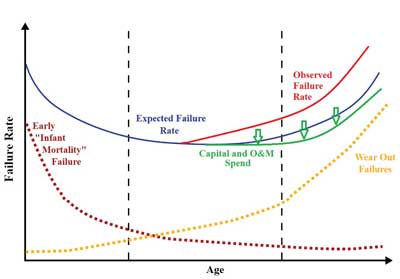 As worldwide wind energy capacity grows, with global installed capacity exceeding 450GW in 2016, ensuring reliable operation of these wind turbine generators (WTGs) becomes very important for owners and operators. The authors have executed several projects to review operational and commissioning challenges of onshore wind farms. In a number of cases, reliability issues early and late in the operational life of the equipment can be traced back to missteps during the commissioning or design phase. In this article, the authors will highlight their experience from a recent root cause investigation of equipment failures, discuss a probabilistic approach to estimating remaining life of WTG components and show actual data that supports these estimates.