



Performance Stability of Continuous Wave Lidars in High Motion, Offshore Environments for Wind Resource Assessments
 Remote sensing on floating offshore platforms such as buoys, barges and ships provides a cost-effective alternative to expensive foundation-mounted offshore wind monitoring towers for wind resource assessment [1][2]. In addition, it is unlikely that foundation-mounted offshore meteorological masts will ever be viable in water depths of over 30 metres, whereas floating platforms can be deployed in more or less any water depth. This will become particularly relevant as floating wind turbines in deep offshore waters start to come on-line.
By Mark Pitter, Scientist and Offshore Applications Leader, and Alex Woodward, Head of Product Development, ZephIR Lidar, UK
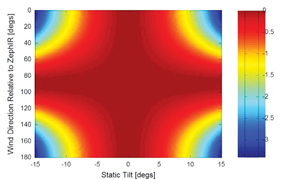
Remote sensors mounted on floating platforms are often subjected to motion. Buoys typically exhibit both translational and rotational motions and these motions have the potential to adversely affect the measurement of the wind vector. In this article the effect of motion on remote sensor performance and in particular the ZephIR 300 Continuous Wave (CW) wind lidar will be described. In addition it will be demonstrated by theory, experimental results and field trials that these motions can be tolerated, or the measurement methodology adapted such that their effect on the accuracy and precision of the wind measurement can be negligible, a unique property of the CW architecture found in all ZephIR lidars.