



 GIS Shows Us How Many Could Be Realised
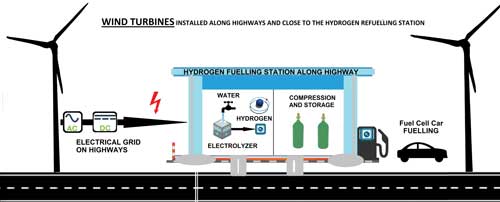
For a hydrogen economy, hydrogen refuelling stations will be needed to provide fuel for vehicles. This could easily be done by retrofitting existing fuel stations. Some of these are located away from urban centres or outside populated areas. On-site wind-powered water electrolysis is a potential solution. The advantage is cost allocation, due to integration of systems with current infrastructures and effective use of energy. In order to estimate the potential of this application, GIS could be used to give us an answer on which to base further system developments. Maps containing road networks, land, wind and station data could be layered and analysed. At TU Delft, Professor Ad van Wijk and PhD student Nikolaos Chrysochoidis-Antsos are working on developing these maps and alternative wind-powered hydrogen production and refuelling concepts.
By Nikolaos Chrysochoidis-Antsos, Technical University of Delft, The Netherlands
 Hydrogen Mobility in Germany
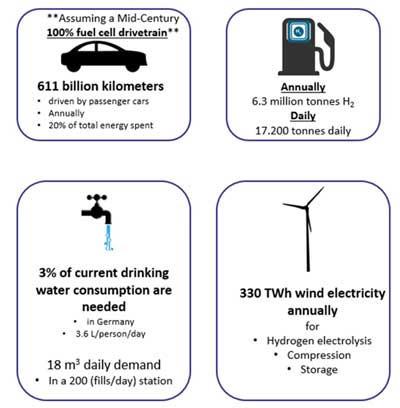
In Germany, passenger vehicles are driven a total of 611 billion kilometres each year. This would require 17,200 tonnes of hydrogen on a daily basis, which would need to be distributed accordingly. Some hydrogen will come as a by-product of industrial processes, or through water electrolysis, or through steam reforming. Green hydrogen comes from water electrolysis. If all hydrogen came from water electrolysis a total of 330TWh of electricity would be needed to cover this annually. Some of this electricity could come from wind energy supplied to the grid, and another smaller part from on-site wind-powered hydrogen production. The hydrogen refuelling stations could utilise this concept. Regarding the water consumption, only 3% of current drinking water consumption would be needed to produce all this hydrogen. For a fuel stations with 200 fills per day this means that 18m3 of drinking water would be needed to feed the electrolyser. These numbers provide a first impression on the feasibility of this economy.