





A Monitoring Approach for Offshore Steel
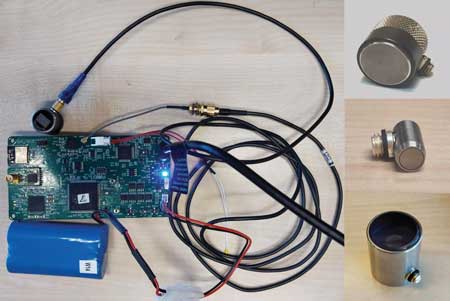 Offshore wind structures operate in highly aggressive environments where salt, moisture and changing weather conditions continuously challenge the integrity of steel components. While uniform corrosion can often be tracked through general thickness loss, localised pitting corrosion introduces a more critical form of degradation due to its confined geometry and strong local effect on material behaviour. Small cavities may develop in isolated areas and remain unnoticed until significant damage has occurred, making early detection difficult, particularly when inspections are separated by months or years. This article describes a practical monitoring approach based on pulse-echo ultrasound, in which a permanently attached sensor repeatedly measures changes in the structural response of a steel component over time. This research has been conducted by Ceit, a technology centre in the Basque Country, as part of the WILLOW project (Wholistic and Integrated digital tools for extended Lifetime and profitability of Offshore Wind farms) funded by the European Union. Laboratory experiments and long-term exposure trials were used to evaluate the capability of this approach to identify changes associated with localised corrosion and to support lifetime assessment through quantitative tracking of pit evolution.
By Marina Perez Diego, Ainhoa Cortés and Andoni Irizar, Centro Tecnológico Ceit, Spain
Attention is placed on how localised corrosion influences ultrasonic wave propagation in steel and how these signal variations can be interpreted for monitoring purposes. The following sections outline the experimental approach, numerical modelling, and long-term observations used to assess detectability under different conditions.