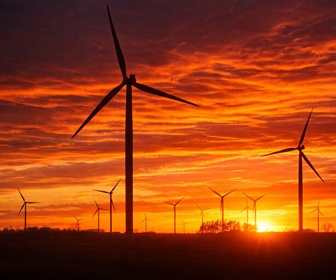





Wind power generation in the USA is forecast to increase by 7.3% in 2026 and a further 4.8% in 2027, according to the latest forecast from the US Energy Information Administration (EIA), analysed by the Sun Day Campaign. Wind is expected to generate 498 billion kilowatt-hours in 2026, up from 464 billion kilowatt-hours in 2025. Generation is forecast to reach 522 billion kilowatt-hours in 2027. Wind's share of total US electricity generation is projected to be about 11.3% in 2026 and 11.7% in 2027.
The EIA forecasts total US electricity generation to increase from 4,275 billion kilowatt-hours in 2025 to 4,392 billion kilowatt-hours in 2026 and 4,456 billion kilowatt-hours in 2027. Electricity consumption increased by 4% in the third quarter of 2026 compared with the same quarter a year earlier.
The commercial sector, which includes data centres, is expected to see electricity demand increase by 2.8% year-on-year in 2027, while industrial demand is forecast to grow by 2.7%. Residential electricity consumption is expected to remain broadly unchanged from 2026.
Renewable sources are forecast to account for 25.8% of US electricity generation in 2026, increasing to 27.5% in 2027. Wind is expected to remain the largest renewable source, followed by solar and hydropower.
Utility-scale solar generation is forecast to increase more rapidly, rising by 21.2% in 2026 and a further 18.3% in 2027. Solar generation is expected to reach 420 billion kilowatt-hours in 2027, compared with 522 billion kilowatt-hours from wind.
The EIA forecasts US wind capacity to increase from approximately 159 GW at the end of 2025 to 170 GW in 2026 and 179 GW in 2027. Solar capacity is expected to increase from approximately 152 GW in 2025 to 182 GW in 2026 and 223 GW in 2027.
Battery storage capacity is also forecast to expand rapidly, from 43 GW in 2025 to 66 GW in 2026 and 91 GW in 2027. Pumped hydro storage capacity is expected to remain broadly unchanged at about 23–24 GW.
Coal's share of US electricity generation is forecast to continue declining, from 17.2% in 2025 to 15.7% in 2026 and 15.0% in 2027. Natural gas is expected to remain the largest source of generation, accounting for about 39.9% in 2026 and 39.2% in 2027.