



New Production and Quality Control Tools for Handling Permanent Magnets
 With the shift towards permanent magnet generators, manufacturers are looking for adequate tooling in order to handle permanent magnets properly. For purposes of convenience these permanent magnets need to be charged at the latest possible stage in the production process. The magnetising solutions for wind-powered generators are opening up new manufacturing possibilities. In this article the author, who is the Technical Director at Metis, describes how his company delivered an automated magnetising solution for a leading manufacturer of wind-power generators, before going on to talk more generally about permanent magnets and then about Metis and its current services and products and future plans.
By Dr Luc L. Van Bockstal, Technical Director, Metis Instruments & Equipment, Belgium .
The actual rotors are for fast-rotating generators. In general, these rotors have a diameter less than 1 metre and are multi-polar. The active length of the rotor – excluding the axes – is around 1 metre. The permanent magnets for such a rotor are typically a high-grade NdFeB (neodymium–iron–boron) magnet with high temperature demagnetisation stability and good corrosion immunity.
When fully packed with charged permanent magnets, the stray magnetic field for such a rotor is important, particularly because of the large size of the pole surfaces. For health and safety purposes the critical region extends at least 1 metre away from the rotor, but even at half a metre away from the rotor, care has to be taken with magnetic objects.
The design of the production unit for fast-rotating machines allowed for the handling of multi-pole rotors with a diameter less than a metre. To make the unit suitable for medium speed machines, with rotor diameters up to 2 metres, some modifications needed to be implemented.
For flexibility, the machine magnetises the rotor in parts, in axial slices as well as circumferentially. On a selected part of the rotor, a strong magnetic field is applied for magnetising the permanent magnets with the correct polarity. The magnetic field is generated by sending a large discharge current through a steel yoke. By rotating the rotor in steps, and moving the yoke axially, the full rotor is covered. The yoke includes magnetic sensors for post-operation quality control of the flux profile.
In fact, the full yoke consists of two independent yokes that are positioned on opposite sides of the rotor in order to balance the mechanical forces during the magnetisation process. Energy-efficient design of the yoke means that energy requirements are reduced to the minimum and that the thermal load of the yoke is reduced to allow for fast cycle times.
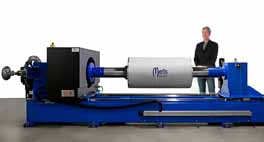
The production unit has a very similar build to a mechanical lathe: when mounting the rotor in the unit, it is fixed on one side using a clamp and on the other side with a counterpoint. The counterpoint can move over a bed that allows rotors with different lengths to be mounted. The side with the clamp is indexed and takes care of the rotation of the rotor. The magnetising yoke is mounted on the same bed as the counterpoint, and can travel in the axial direction.
After mounting the rotor, the unit double-checks the selected rotor magnetisation program by verifying some typical parameters such as diameter and active length. The magnetisation process of the full rotor is then made by stepping over the entire active surface. As a final check, a surface scan of the flux of the rotor is made.
Introducing PMG
Generators used in wind turbines are broadly of two types: synchronous and asynchronous (induction). From discussions and meetings with design engineers from the biggest players in the turbine market, Metis believes that the trend is definitely for permanent magnet solutions, respectively gearbox or direct driven.
A permanent magnet generator (PMG) is a simple form of a synchronous generator requiring no electrical connections to the rotor because it carries permanent magnets instead of windings, and is thus the preferred solution with respect to service and maintenance. The source of the magnetism, which creates the magnetic field, is a permanent magnet, such as high strength neodymium–iron–boron. Moreover, the fact that PMGs provide an overall increase in efficiency at part load operation, compared to conventional generators, leads Metis to believe that this technology will be in pole position in the competition for future designs.
Because handling permanent magnets is dangerous to workshop and warehouse personnel due to the very strong and invisible magnetic forces, and the additional problem of dirt collecting during storage, these magnets require precautionary measures to be taken. The handling of pre-magnetised magnets needs to be avoided and in situ magnetisation is a preferred solution to avoid injuries and dust collection. Non-magnetised material can be safely produced, packed in smaller containers and transported without hazardous labelling. The individual magnets (up to hundreds) or magnetic assemblies can easily be mounted upon the rotor without using power-intensive and complex tooling, even when just using manual power.
Real-time inspection is possible on the magnetising installation itself. The measurement of the magnetic flux (via an integrated flux coil in the magnetising fixture) allows direct, in-stand, quality control of the complete magnetised rotor parameters. It can also ensure that the generator produced meets the design parameters before mounting the stator and rotor together.
The Metis Company
Metis Instrument & Equipment NV, a spin-off of the university from Leuven in Belgium, started in 1998 as a manufacturer of advanced research equipment for generating high magnetic fields and related magnetic measurement capabilities.
Whereas the product portfolio of Metis Instruments still contains research equipment for measuring physical properties in magnetic fields up to 50T, the largest diversification has taken place in its industrial equipment.
Over the last few years Metis has been involved in developing new magnetising techniques. Pulsed power sources and magnetising fixtures (coils) that convert the electrical energy into magnetic fields became very important with the arrival of new applications that integrated rare earth materials.
Metis is well known for its energy efficiency and control of magnetic profiles, guaranteeing the most energy-economic solution available without compromising performance. An energy reduction by a factor of 3 to 4 compared with conventional magnetising technology has already been achieved.
The energy-efficient magnetising yokes have several advantages. In part this is because of the reduction in power consumption and the investment costs in the power supply, but also because the heat load on the yoke is reduced, resulting in faster repetition rates.
In order to support customers in the prototype and 0-series phase, the company is offering prototype magnetisation services. In the prototype magnetisation service, the customer can have the use of a versatile and automated magnetising unit, with trained personnel, at the company’s own location. The tooling for the support and manipulation of the rotor and the magnetising yoke are laid out so that only minor adaptations are required to match it to the customer’s rotor.
The advantage of this service is that the customer can bring an 0-series product to the market that will be produced in exactly the same way as those made in a dedicated production unit. With the availability of the prototyping service, the time to market of the prototype and 0-series can be drastically reduced.
In parallel to the progress in magnetising technology, the measurement systems for the quality control of magnetic materials have been developed too. This has led to the introduction of the HyMPulse, a system for measuring the magnetic properties of the new generation of permanent magnets with high coercivity. Additionally, the device can measure free-form samples, which allows for the inspection of the end product, thus eliminating the need for sample preparation.
The range of measurement equipment is further elaborated with the HyMAC/HyMDC systems for measuring the magnetic properties of soft and semi-hard magnetic materials and a magnetic measurement tool for the steel industry.
Future Activities and Outlook
Metis Instruments is dedicated to supporting PMG developers and manufacturers with its involvement going from pre-production, through prototype magnetisation, to the commissioning of fully automated production units on site. The company will continue to explore the advantages of energy-efficient magnetising devices, especially in the area of large systems where their application can be particularly rewarding.
The automated magnetising units have been shown to be effective in the production of fast-rotating wind-power generators as well as in large electrical drives. In addition, the company is active in developing solutions for direct-drive permanent generators. The biggest challenge there is related to the larger surface of all the magnetic poles; engineering an adequate solution for handling and repetition rate are the key elements.
Metis will continue to be an industry innovator in the design of magnetising fixtures and magnetising process control. Our customers continue to benefit from our proven track record in turnkey production units, many of which are already providing combined solutions in magnetising installations run by some of the world’s leading companies.{/access}
With the shift towards permanent magnet generators, manufacturers are looking for adequate tooling in order to handle permanent magnets properly. For purposes of convenience these permanent magnets need to be charged at the latest possible stage in the production process. The magnetising solutions for wind-powered generators are opening up new manufacturing possibilities. In this article the author, who is the Technical Director at Metis, describes how his company delivered an automated magnetising solution for a leading manufacturer of wind-power generators, before going on to talk more generally about permanent magnets and then about Metis and its current services and products and future plans.By Dr Luc L. Van Bockstal, Technical Director, Metis Instruments & Equipment, Belgium .
{access view=!registered}Only logged in users can view the full text of the article.{/access}{access view=registered}Metis Delivers Magnetising for PMG
Metis Instruments recently delivered an automated magnetising solution to a leading manufacturer of wind-power generators; on this occasion a completely autonomous production unit for rotors with variable length was installed. The challenge was to deliver a unit that would eliminate the need to handle charged permanent magnets during the production with a limited transit time.The actual rotors are for fast-rotating generators. In general, these rotors have a diameter less than 1 metre and are multi-polar. The active length of the rotor – excluding the axes – is around 1 metre. The permanent magnets for such a rotor are typically a high-grade NdFeB (neodymium–iron–boron) magnet with high temperature demagnetisation stability and good corrosion immunity.
When fully packed with charged permanent magnets, the stray magnetic field for such a rotor is important, particularly because of the large size of the pole surfaces. For health and safety purposes the critical region extends at least 1 metre away from the rotor, but even at half a metre away from the rotor, care has to be taken with magnetic objects.
The design of the production unit for fast-rotating machines allowed for the handling of multi-pole rotors with a diameter less than a metre. To make the unit suitable for medium speed machines, with rotor diameters up to 2 metres, some modifications needed to be implemented.
For flexibility, the machine magnetises the rotor in parts, in axial slices as well as circumferentially. On a selected part of the rotor, a strong magnetic field is applied for magnetising the permanent magnets with the correct polarity. The magnetic field is generated by sending a large discharge current through a steel yoke. By rotating the rotor in steps, and moving the yoke axially, the full rotor is covered. The yoke includes magnetic sensors for post-operation quality control of the flux profile.
In fact, the full yoke consists of two independent yokes that are positioned on opposite sides of the rotor in order to balance the mechanical forces during the magnetisation process. Energy-efficient design of the yoke means that energy requirements are reduced to the minimum and that the thermal load of the yoke is reduced to allow for fast cycle times.
The production unit has a very similar build to a mechanical lathe: when mounting the rotor in the unit, it is fixed on one side using a clamp and on the other side with a counterpoint. The counterpoint can move over a bed that allows rotors with different lengths to be mounted. The side with the clamp is indexed and takes care of the rotation of the rotor. The magnetising yoke is mounted on the same bed as the counterpoint, and can travel in the axial direction.
After mounting the rotor, the unit double-checks the selected rotor magnetisation program by verifying some typical parameters such as diameter and active length. The magnetisation process of the full rotor is then made by stepping over the entire active surface. As a final check, a surface scan of the flux of the rotor is made.
Introducing PMG
Generators used in wind turbines are broadly of two types: synchronous and asynchronous (induction). From discussions and meetings with design engineers from the biggest players in the turbine market, Metis believes that the trend is definitely for permanent magnet solutions, respectively gearbox or direct driven.
A permanent magnet generator (PMG) is a simple form of a synchronous generator requiring no electrical connections to the rotor because it carries permanent magnets instead of windings, and is thus the preferred solution with respect to service and maintenance. The source of the magnetism, which creates the magnetic field, is a permanent magnet, such as high strength neodymium–iron–boron. Moreover, the fact that PMGs provide an overall increase in efficiency at part load operation, compared to conventional generators, leads Metis to believe that this technology will be in pole position in the competition for future designs.
Because handling permanent magnets is dangerous to workshop and warehouse personnel due to the very strong and invisible magnetic forces, and the additional problem of dirt collecting during storage, these magnets require precautionary measures to be taken. The handling of pre-magnetised magnets needs to be avoided and in situ magnetisation is a preferred solution to avoid injuries and dust collection. Non-magnetised material can be safely produced, packed in smaller containers and transported without hazardous labelling. The individual magnets (up to hundreds) or magnetic assemblies can easily be mounted upon the rotor without using power-intensive and complex tooling, even when just using manual power.
Real-time inspection is possible on the magnetising installation itself. The measurement of the magnetic flux (via an integrated flux coil in the magnetising fixture) allows direct, in-stand, quality control of the complete magnetised rotor parameters. It can also ensure that the generator produced meets the design parameters before mounting the stator and rotor together.
The Metis Company
Metis Instrument & Equipment NV, a spin-off of the university from Leuven in Belgium, started in 1998 as a manufacturer of advanced research equipment for generating high magnetic fields and related magnetic measurement capabilities.
Whereas the product portfolio of Metis Instruments still contains research equipment for measuring physical properties in magnetic fields up to 50T, the largest diversification has taken place in its industrial equipment.
Over the last few years Metis has been involved in developing new magnetising techniques. Pulsed power sources and magnetising fixtures (coils) that convert the electrical energy into magnetic fields became very important with the arrival of new applications that integrated rare earth materials.
Metis is well known for its energy efficiency and control of magnetic profiles, guaranteeing the most energy-economic solution available without compromising performance. An energy reduction by a factor of 3 to 4 compared with conventional magnetising technology has already been achieved.
The energy-efficient magnetising yokes have several advantages. In part this is because of the reduction in power consumption and the investment costs in the power supply, but also because the heat load on the yoke is reduced, resulting in faster repetition rates.
In order to support customers in the prototype and 0-series phase, the company is offering prototype magnetisation services. In the prototype magnetisation service, the customer can have the use of a versatile and automated magnetising unit, with trained personnel, at the company’s own location. The tooling for the support and manipulation of the rotor and the magnetising yoke are laid out so that only minor adaptations are required to match it to the customer’s rotor.
The advantage of this service is that the customer can bring an 0-series product to the market that will be produced in exactly the same way as those made in a dedicated production unit. With the availability of the prototyping service, the time to market of the prototype and 0-series can be drastically reduced.
In parallel to the progress in magnetising technology, the measurement systems for the quality control of magnetic materials have been developed too. This has led to the introduction of the HyMPulse, a system for measuring the magnetic properties of the new generation of permanent magnets with high coercivity. Additionally, the device can measure free-form samples, which allows for the inspection of the end product, thus eliminating the need for sample preparation.
The range of measurement equipment is further elaborated with the HyMAC/HyMDC systems for measuring the magnetic properties of soft and semi-hard magnetic materials and a magnetic measurement tool for the steel industry.
Future Activities and Outlook
Metis Instruments is dedicated to supporting PMG developers and manufacturers with its involvement going from pre-production, through prototype magnetisation, to the commissioning of fully automated production units on site. The company will continue to explore the advantages of energy-efficient magnetising devices, especially in the area of large systems where their application can be particularly rewarding.
The automated magnetising units have been shown to be effective in the production of fast-rotating wind-power generators as well as in large electrical drives. In addition, the company is active in developing solutions for direct-drive permanent generators. The biggest challenge there is related to the larger surface of all the magnetic poles; engineering an adequate solution for handling and repetition rate are the key elements.
Metis will continue to be an industry innovator in the design of magnetising fixtures and magnetising process control. Our customers continue to benefit from our proven track record in turnkey production units, many of which are already providing combined solutions in magnetising installations run by some of the world’s leading companies.{/access}