



 The wind energy sector in the USA combines a substantial installed capacity base with increasing political and regulatory uncertainty. As an early adopter of modern wind technology, the country has developed a strong domestic market that remains among the largest globally. However, its growth trajectory is now shaped by policy shifts, regional disparities, and a growing reliance on non-federal drivers.
The US wind industry originated in the 1980s with large turbine clusters in California, notably at Altamont Pass. These early developments demonstrated the viability of utility-scale wind and laid the foundation for further expansion. Supported by federal tax incentives and state renewable portfolio standards, capacity grew steadily over the following decades.
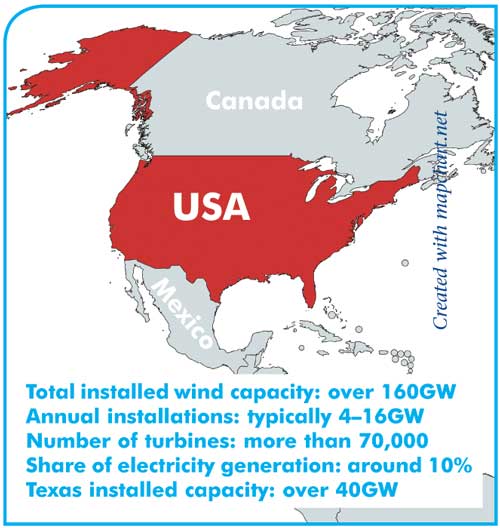
By 2008–2009, the USA had become the global leader in newly installed wind capacity. Growth was driven in part by states such as Texas, where strong wind resources and grid investment enabled large-scale deployment. Texas remains the leading wind state, with installed capacity exceeding 40GW, followed by Iowa, Oklahoma and Kansas.
After 2010, the global landscape shifted as China rapidly expanded its manufacturing and installation capacity, surpassing the USA in cumulative wind capacity. Since then, China has maintained a significantly higher rate of annual installations, while the USA has continued to grow at a more moderate pace.
Installed Capacity and Generation Profile
Total installed wind capacity in the USA now exceeds 160GW, with more than 70,000 utility-scale turbines in operation. Wind energy supplies around 10% of national electricity demand, making it a central component of the generation mix in several regions.
Annual installations have fluctuated between approximately 4GW and 16GW in recent years. This variability reflects policy cycles, particularly the timing of federal tax incentives, as well as supply chain and permitting factors.
Onshore wind accounts for almost all installed capacity. Offshore wind remains limited, with only a small number of operational projects and several developments underway along the east coast. Transmission constraints in high-resource regions, particularly in central USA, continue to influence deployment patterns.
Policy Support and Subsequent Uncertainty
The Inflation Reduction Act (2022) provided renewed support for wind energy through extended tax incentives, including the Production Tax Credit and Investment Tax Credit. These measures improved project economics and supported a stronger development pipeline, as well as encouraging domestic manufacturing.
However, subsequent policy changes have reduced the stability of this framework. Adjustments to federal support mechanisms have created uncertainty for developers, complicating long-term planning and investment decisions. As a result, the market has become more dependent on state policies and private sector demand.
Political and Social Constraints
Political opposition remains a key factor affecting the sector. Federal-level actions to limit new developments and adjust regulatory frameworks have increased the risk for project developers. At the same time, state-level approaches vary significantly.
States such as Texas and Iowa continue to expand wind capacity, recognising the economic contribution of wind energy through job creation and land lease income. In contrast, other states have introduced zoning restrictions or temporary bans on new projects.
Local opposition has also contributed to delays in some areas. Concerns related to health impacts and property values, despite limited supporting evidence, highlight the need for continued community engagement and transparent communication.
Role of Corporate Demand and Regional Initiatives
In the absence of consistent federal direction, corporate demand has become an important driver of new capacity. Large electricity consumers continue to secure long-term power purchase agreements to meet renewable energy targets, providing revenue stability for developers.
Municipal and regional authorities are also supporting deployment through independent renewable energy goals. In some cases, these targets exceed national ambitions, reinforcing demand for wind generation at the local level.
Technology Progress and Future Outlook
Technological improvements continue to enhance the competitiveness of wind energy in the USA. Larger turbines, higher efficiency, and digital optimisation are contributing to lower costs and improved performance. Distributed wind applications are also emerging, particularly in rural and commercial settings.
Further growth will depend on grid expansion and modernisation to integrate higher levels of wind generation. Transmission infrastructure remains a critical factor, especially in regions with strong wind resources but limited grid capacity.
The US wind sector is well established but faces ongoing structural challenges. Its future development will depend on balancing policy uncertainty with continued investment, technological progress, and demand from corporate and regional actors. While growth may remain uneven, wind energy is expected to retain a significant role in the national electricity system.
This article is based on the following audio/video WWEA podcast:
Episode 28: Wind Power in Italy: Doubling Wind Power by 2030.
https://wwindea.org/WWEApodcast