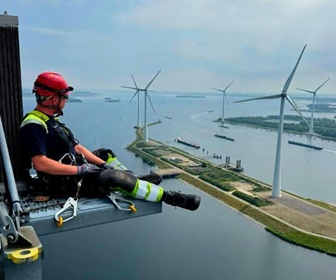





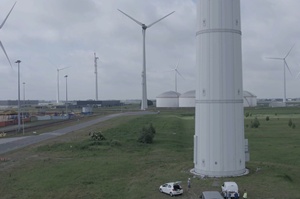
 TNO, Dopplium and RWE are testing a radar-based monitoring system at Eemshaven in the Netherlands that tracks bats in real time. The technology could enable targeted turbine shutdowns when bats are at risk, rather than relying on broad precautionary shutdowns. The installation is part of the Turbine Bat Trace project, which started on 1 January 2026 with support from the Netherlands Enterprise Agency (RVO) through the EKOO Electricity 2025 programme. The system uses BatGuardian, a radar-based bat detection technology developed by Dopplium.
Three compact radar units are mounted around the turbine to provide 360-degree coverage of the surrounding airspace. This could allow turbines to respond locally when bats are detected.
Dopplium's radar technology was developed from research conducted by the Microwave Sensing, Signals and Systems (MS3) group at Delft University of Technology, focusing on millimetre-wave radar and signal processing. The system can operate in darkness and challenging weather conditions.
TNO has integrated the radar system with other sensors installed in and around the turbine, including thermal infrared cameras, ultrasonic bat microphones, acoustic monitoring systems and panoramic cameras.
The different detection methods allow the project partners to cross-check sensor data. Thermal cameras provide visual confirmation of bats, while ultrasonic microphones record species-specific echolocation calls. Panoramic cameras provide information about the surrounding environment.
The combined data is being used to study three-dimensional movement patterns, species identification and bat behaviour around the rotating rotor.
The next phase will focus on optimising the radar algorithms using field data, investigating three-dimensional detection capabilities and assessing potential applications offshore, where monitoring bats is more difficult because of distance, weather conditions and infrastructure.