



 Thinking about any possible application that a wind turbine blade can be used for without too much processing or recycling to extract the original components led to this idea. Whether or not it is practical from an engineering perspective or a financial viewpoint is to be seen/judged by the experts in the trade. Undoubtedly, for several legitimate reasons, it has taken a long time for industry players to begin incorporating recyclable turbine blades, or blade recycling for other purposes, into their future plans.
By Ahmad Hemami, McGill University, Montreal, Canada
One obvious reason among others is the cost involved even for breaking these huge and awkward form objects into smaller and more manageable pieces.
The best application for them is probably if they can be used as they are, which involves only the transportation plus the cost of adaptation to the particular application.
As we know, according to Equinor [1], the first floating wind farm in the world (Hywind Scotland pilot park) has been in operation since 2017. In other words, the floating wind farm concept is pretty new and open to many modifications, adjustments and advancements. In this respect, the floating platforms that are now in service, could be experimental, under study, not optimised and subject to alterations. Each of these platforms (Spar, Semi Submersible, Tension Leg Platform, and Barge) and their variations (for instance, steel or concrete for material, or central-column design in submersible foundation), used in one or more wind farms so far, may lead to later refined and optimised versions.
We cannot say which design is the best. Based on the advantages and disadvantages of each platform, one can be more appropriate for a particular site based on water depth, waves, and other factors. Nonetheless, in the current stage, each individual group in a category can be overdesigned, heavier than it should be, or in need of improvement(s).
Obviously, the main characteristic common between all platform designs is that they need to be floating and be able to provide buoyancy to themselves as well as to their load (the wind turbine) under all operating conditions that may arise. Buoyancy in this context can be obtained only by hollowness, since the materials to be used are heavier than water.
Now, looking at a wind turbine blade, it is a hollow object if sealed at its end. Thus, it has a high degree of buoyancy, and it can shift up the centre of buoyancy when combined with a floating object while lowering the centre of mass, thus increasing stability. In this respect, if it is a part of a floating platform, its contribution is reducing the size of the platform for the same load.
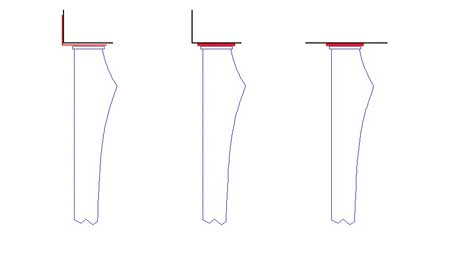
Sealing a blade cannot be a difficult task to do. But a sort of bracket is needed to attach the blade to a platform. Possibly attaching a blade to a barge needs a simpler bracket than the other foundations. Without going into any details, we consider if a barge carries a number of these blades underneath its body. Figure 1 illustrates a few schematic scenarios if the blade is attached to the side of the barge or underneath the body.
A turbine blade has a large number of bolts for joining to the turbine hub since it must bear all the aerodynamic and other forces. However, for this application it does not need that many bolts. This is important from the viewpoint that this operation of attaching to either the side or the bottom of a barge needs to be done on the site and inside the water. The blade also needs to be kept in the vertical position until the job is completed. This implies that blades cannot be installed onshore and must be carried to the site. This adds to the complexity of the operation and its relevant cost. Nevertheless, for the experts in transportation and installation of spar type platforms, this is neither new nor impossible.
In addition to size reduction and increasing stability, another advantage that this concept offers is damping the unwanted motions of a platform induced by wind and wave forces (especially yaw, pitch, sway and surge). In my view this idea has potential and it is worth experiencing.
To have a better picture of the effect of adding a hollow object under a floating platform, we can study an example containing numbers that are rounded but not far from actualities.
Consider an 8,000-tonne barge. When floating the weight of the displaced water is 8,000 cubic metres. If now a hollow body of 500 tonnes weight and 1000 cubic metres volume is attached to its underneath, it adds 500 tonnes to the barge weight, while it has an equivalent to 1000 tonnes of upward buoyancy force. One half of the buoyancy force goes toward its own weight, while it exerts 500 tonnes equivalent upward force to the barge. As a result, the barge can be 7,500 tonnes without a change in how much of it is inside water, for the same load.
Further reading
[1] Hywind Scotland - the world’s first floating wind farm - Equinor (https://www.equinor.com/energy/hywind-scotland)