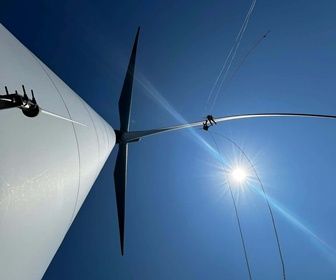




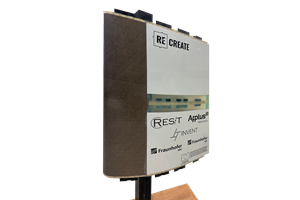
 For future wind turbines, Fraunhofer IWU, together with partners in the EU-funded RECREATE project, is developing new approaches to material selection, joining technologies and design. The aim is to enable wear-prone components to be replaced and to manufacture them from recyclable materials. The research rotor blade features a modular design, with all components bonded around a continuous load-bearing spar.
The leading edge, made of thermoplastics reinforced with natural fibres, can be replaced using a detachable adhesive joint. As leading-edge wear increases, aerodynamic performance and efficiency decline, making timely replacement important to maintain long-term turbine performance.
The demonstrator also explores design-for-manufacturing concepts aimed at enabling rotor blades to be produced more economically in Europe through a higher degree of automation. One approach is the use of pultrusion, where continuous fibres are drawn through a resin bath, cured in a heated die and formed into profiles. The spar, for example, can be produced as a continuous profile and cut to length. For the leading edge, organo sheets – fibre-reinforced composite semi-finished products made of continuous fibres in a thermoplastic matrix – can be heated and formed in an automated process.
Natural fibre-reinforced thermoplastics are considered more suitable for reuse, repair, refurbishment, remanufacturing and recycling than glass fibre-reinforced thermoplastics. They show greater robustness over multiple use and recycling cycles and exhibit fewer critical damage mechanisms.
This supports improved integration into circular design concepts, particularly for mechanical recycling, where end-of-life components are shredded, remelted and processed into new materials. Compared with glass fibre-reinforced thermoplastics, natural fibre-based materials better tolerate fibre shortening, as their reinforcing properties decline more gradually.
The RECREATE project brings together around 20 partners from research and industry and is coordinated by Politecnico di Milano in Italy. Alongside Fraunhofer IWU and Fraunhofer WKI, partners involved in the rotor blade demonstrator include INVENT, RES-T and RESCOLL Applus. The project has received funding from the European Union’s Horizon 2020 research and innovation programme.
Additional partners include Tampere University (Finland), ICAM Ouest (France), University of Patras (Greece), Fundación Gaiker (Spain), CNRS (France), Iris Technology Solutions (Spain), Cobat Compositi (Italy), Rescoll (France), N. Benasedo (Italy), Carbon Cleanup (Austria), EDAG Engineering Group (Switzerland), HEAD Sport (Austria), Geven (Italy), APRA Europe (Belgium), AVK – Federation of Reinforced Plastics (Germany), Grifo Multimedia (Italy) and Giacomelli Media Management (Slovenia).
Image courtesy Fraunhofer IWU