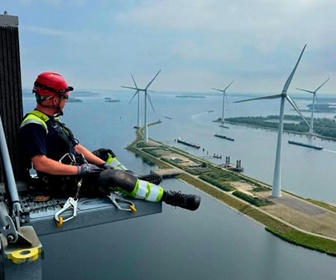





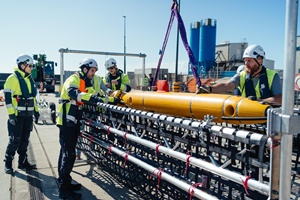
 The SeaMe project (Sustainable Ecosystem Approach in Monitoring the Marine Environment) has completed its initial offshore test phase. Over two years, five monitoring technologies were tested off Heligoland, Germany, and at RWE’s Kaskasi offshore wind farm.
The technologies collected biological and physical environmental data simultaneously, demonstrating how non-invasive, low-emission methods can improve marine monitoring while reducing disturbance. Initial data are now available through an online portal for researchers, authorities, industry and the public. Further data collection is planned from March to September 2027.
RWE worked with industry and research partners to develop and test the technologies:
- BioConsult SH used long-range drones to survey birds and marine mammals, reducing fuel consumption by up to 90% compared with conventional aircraft surveys.
- Spoor tested high-resolution cameras with artificial intelligence to monitor bird activity at offshore wind turbines continuously, with expert-verified species identification.
- Anemo Robotics developed underwater cameras for long-term observation of fish and seabed organisms. More than 860 hours of footage have been recorded and analysed automatically.
- The German Research Centre for Artificial Intelligence (DFKI) adapted an autonomous underwater vehicle to collect biological and physical environmental data simultaneously.
- The Helmholtz Institute for Functional Marine Biodiversity at the University of Oldenburg (HIFMB) and the Alfred Wegener Institute (AWI) analysed environmental DNA samples, identifying 226 species or 255 biological groups across 17 animal phyla.
- DHI developed the SeaMe data portal and an analytical framework linking biological and physical datasets to examine ecological relationships and support future monitoring programmes.
The project’s main objective is to combine data from different monitoring methods to provide a more comprehensive picture of marine ecosystems. Linking species observations with physical environmental conditions can help researchers investigate ecological changes and relationships. The findings are being analysed for scientific publications, while several technologies are being further developed for renewed deployment at Kaskasi in 2027.