



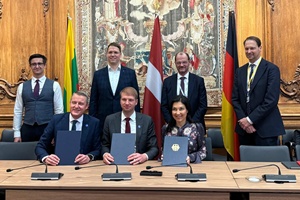
 The energy ministers of Lithuania, Latvia and Germany have signed a joint declaration of intent in Paris on cross-border renewable electricity capacity and infrastructure. The agreement sets out cooperation on the proposed Baltic-German PowerLink, a hybrid offshore interconnection between the Baltic States and Germany.
Under the declaration, the Lithuanian, Latvian and German transmission system operators — Litgrid, Augstsprieguma tīkls and 50Hertz — will assess the technical and economic feasibility of the project. The hybrid connection would link Germany and the Baltic countries via a subsea electricity cable while also enabling the development and integration of new renewable generation capacity.
The current concept envisages a 2 GW hybrid offshore interconnection of around 600 km. The planned connection point in the Baltic States would be located near the Lithuania–Latvia border, with the exact site to be determined following technical studies. The project could be completed by 2037.
In addition to enabling electricity trading between the Baltic countries and Germany, the interconnector could support the integration of up to 2 GW of offshore wind capacity in Lithuania and Latvia, alongside further onshore renewable energy development.
The three governments will continue to support studies carried out by the transmission system operators and other institutions, including cost-benefit analyses, financing models and technical solutions. Based on the results of these preliminary assessments, the partners will consider applying for Project of Common Interest status within the European Union and seeking EU funding for detailed studies. Other European Union countries in the Baltic Sea region may join the initiative at a later stage.
Earlier this year, Litgrid, Augstsprieguma tīkls and 50Hertz submitted a joint application to include the project — previously referred to as the Baltic Hub — in the 2026 Ten-Year Network Development Plan of the European Network of Transmission System Operators for Electricity. As part of that process, an EU-level assessment will examine the project’s impact on the electricity market and security of supply, and its eligibility for future European Union funding.
Decisions on the next steps for the Baltic-German PowerLink are expected by the end of the third quarter of 2026.