



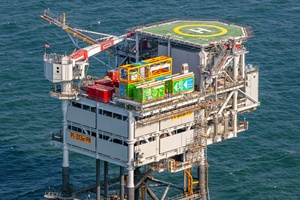
 The PosHYdon pilot project has produced its first green hydrogen on the operational Q13a-A offshore platform, operated by Eni Energy Netherlands using electricity generated by offshore wind. Located around 13 kilometres off the coast of Scheveningen in the Dutch sector of the North Sea, the fully electrified Q13a-A platform converts seawater into demineralised water, which is then used to produce hydrogen through electrolysis powered by offshore wind energy.
The pilot aims to demonstrate the integration of offshore energy systems while assessing hydrogen production in a marine environment. It is also evaluating how efficiently an electrolyser operates with the variable output of offshore wind, while gathering data on operating costs, maintenance requirements and overall system performance.
During the initial test phase, the project is focused on achieving stable hydrogen production. Later trials will assess how effectively the system responds to fluctuations in offshore wind generation. The findings will be analysed during August and September, with results expected to be published in the autumn.
PosHYdon is a collaboration between Deme, EBN, Eneco, Emerson, Gasunie, Hatenboerwater, Investa Expertise Centrum, IV Offshore & Energy, Nel, Eni, Nexstep, NGT, Nogat, TAQA and TNO.